
| Là-bas se trouvent quelques productions de |

|
la descendance ! |
Please be aware that the texts given below may not be the ones that are finally published, especially if the paper is less than three years old. I will send the proper final version to anyone who requests it.
 We examine additive properties of denses subsets of sifted sequences, and
in particular prove under very general assumptions that such a sequence is
an additive asymptotic basis whose order is very well controled.
We examine additive properties of denses subsets of sifted sequences, and
in particular prove under very general assumptions that such a sequence is
an additive asymptotic basis whose order is very well controled.
 We prove that the number of primes in an interval of length $N$ is at
most $2N/(\log N+3.53)$ when $N$ is large enough.
This is obtained through a sieving process which can be seen as a hybrid between
the large sieve and the Selberg sieve, and draws on what we call "local
models".
We prove that the number of primes in an interval of length $N$ is at
most $2N/(\log N+3.53)$ when $N$ is large enough.
This is obtained through a sieving process which can be seen as a hybrid between
the large sieve and the Selberg sieve, and draws on what we call "local
models".
 When $K\ge1$ is an integer and $S$ is a set of prime numbers
in the interval $(N/2,N]$ with $|S|\ge \pi^*(N)/K$, where $\pi^*(N)$
is the number of primes in this interval, we obtain an upper bound for
the additive energy of $S$, which is the number of quadruples
$(x_1,x_2,x_3,x_4)$ in $S^4$ satisfying $x_1+x_2=x_3+x_4$. We obtain
this bound by a variant of a method of Ramaré and I. Ruzsa.
Taken together with an argument due to N. Hegyvári and
F. Hennecart this bound implies that when the sequence of prime
numbers is coloured with $K$ colours, every sufficiently large integer
can be written as a sum of no more than $CK \log \log 4K$ prime
numbers, all of the same colour, where $C$ is an absolute constant.
This assertion is optimal upto the value of $C$ and answers a question
of A. Sárközy.
When $K\ge1$ is an integer and $S$ is a set of prime numbers
in the interval $(N/2,N]$ with $|S|\ge \pi^*(N)/K$, where $\pi^*(N)$
is the number of primes in this interval, we obtain an upper bound for
the additive energy of $S$, which is the number of quadruples
$(x_1,x_2,x_3,x_4)$ in $S^4$ satisfying $x_1+x_2=x_3+x_4$. We obtain
this bound by a variant of a method of Ramaré and I. Ruzsa.
Taken together with an argument due to N. Hegyvári and
F. Hennecart this bound implies that when the sequence of prime
numbers is coloured with $K$ colours, every sufficiently large integer
can be written as a sum of no more than $CK \log \log 4K$ prime
numbers, all of the same colour, where $C$ is an absolute constant.
This assertion is optimal upto the value of $C$ and answers a question
of A. Sárközy.
 For any integer $K\ge1$ let $s(K)$ be the smallest integer
such that in any colouring of the set of squares of the
integers in $K$ colours every large enough integer can be
written as a sum of no more than $s(K)$ squares, all of the same
colour. A problem proposed by Sárközy asks for optimal bounds
for $s(K)$ in terms of $K$. It is known by a result of Hegyvéri
and Hennecart that $s(K)\ge K\exp((\log2+o(1))\log K\log\log K)$. In this
article we show that $s(K)\le K\exp((3\log 2+o(1))\log K\log\log K)$. This
improves on the bound $s(K)\ll_\epsilon K^{2+\epsilon}$, which is the best available
upper bound for $s(K)$.
For any integer $K\ge1$ let $s(K)$ be the smallest integer
such that in any colouring of the set of squares of the
integers in $K$ colours every large enough integer can be
written as a sum of no more than $s(K)$ squares, all of the same
colour. A problem proposed by Sárközy asks for optimal bounds
for $s(K)$ in terms of $K$. It is known by a result of Hegyvéri
and Hennecart that $s(K)\ge K\exp((\log2+o(1))\log K\log\log K)$. In this
article we show that $s(K)\le K\exp((3\log 2+o(1))\log K\log\log K)$. This
improves on the bound $s(K)\ll_\epsilon K^{2+\epsilon}$, which is the best available
upper bound for $s(K)$.

 Strengthening work of Rosser,
Schoenfeld, and McCurley, we establish explicit Chebyshev-type
estimates in the prime number theorem for arithmetic progressions, for
all moduli $k \le 72$ and other small moduli.
Strengthening work of Rosser,
Schoenfeld, and McCurley, we establish explicit Chebyshev-type
estimates in the prime number theorem for arithmetic progressions, for
all moduli $k \le 72$ and other small moduli.
 For many years, Paul Erdös has asked intriguing questions
concerning the prime divisors of binomial coefficients, and the
powers to which they appear. It is evident that, if $k$ is not too
small, then ${n\choose k}$ must be highly composite in that it contains many
prime factors and often to high powers. It is therefore of
interest to enquire as to how infrequently ${n\choose k}$ is squarefree. One
well-known conjecture, due to Erdös, is that ${2n\choose n}$ is not squarefree
once $n \ge 5$. Sarközy proved this for sufficiently large $n$
but here we return to and solve the original question.
For many years, Paul Erdös has asked intriguing questions
concerning the prime divisors of binomial coefficients, and the
powers to which they appear. It is evident that, if $k$ is not too
small, then ${n\choose k}$ must be highly composite in that it contains many
prime factors and often to high powers. It is therefore of
interest to enquire as to how infrequently ${n\choose k}$ is squarefree. One
well-known conjecture, due to Erdös, is that ${2n\choose n}$ is not squarefree
once $n \ge 5$. Sarközy proved this for sufficiently large $n$
but here we return to and solve the original question.
 We prove that, if $x$ and $q\leqslant
x^{1/16}$ are two parameters, then for any invertible residue class
$a$ modulo $q$ there exists a product of exactly three primes, each
one below $x^{1/3}$, that is congruent to $a$ modulo $q$.
We prove that, if $x$ and $q\leqslant
x^{1/16}$ are two parameters, then for any invertible residue class
$a$ modulo $q$ there exists a product of exactly three primes, each
one below $x^{1/3}$, that is congruent to $a$ modulo $q$.

 We prove that, for any
$y>1$ and $q \leq y^{1/3}/900$, for any invertible residue class
$a$
modulo~$q$, there exist primes $p_1$,
$p_2$, $p_3$, all below $y$, such that $p_1 p_2 p_3 \equiv a
[q]$. The appendix provide a fast proof of the case of
Kneser's Theorem we use.
We prove that, for any
$y>1$ and $q \leq y^{1/3}/900$, for any invertible residue class
$a$
modulo~$q$, there exist primes $p_1$,
$p_2$, $p_3$, all below $y$, such that $p_1 p_2 p_3 \equiv a
[q]$. The appendix provide a fast proof of the case of
Kneser's Theorem we use.
 For any $\epsilon>0$, there exists
$q_0(\epsilon)$ such for any $q\ge q_0(\epsilon)$ and any invertible residue
class $a$ modulo~$q$, there exists a natural number
that is congruent to $a$ modulo~$q$ and that
is the product of exactly three primes, all of which are below
$q^{\frac{3}{2}+\epsilon}$.
If we restrict our attention to odd moduli $q$ that do not have prime
factors congruent to~1 mod~4, we can find
such primes below $q^{\frac{11}{8}+\epsilon}$.
If we further
restrict our set of moduli to prime $q$ that are such that
$(q-1,4\cdot7\cdot11\cdot17\cdot23\cdot29)=2$, we can find
such primes below $q^{\frac{6}{5}+\epsilon}$. Finally, for any $\epsilon>0$, there exists
$q_0(\epsilon)$ such that when $q\ge q_0(\epsilon)$, there exists a natural number
that is congruent to $a$ modulo~$q$ and that
is the product of exactly four primes, all of which are below
$q(\log q)^6$.
For all $q\ge 2$ and for all invertible residue
classes $a$ modulo~$q$, there exists a natural number
that is congruent to $a$ modulo~$q$ and that
is the product of exactly three primes, all of which are below
$(10^{15}q)^{5/2}$.
For any $\epsilon>0$, there exists
$q_0(\epsilon)$ such for any $q\ge q_0(\epsilon)$ and any invertible residue
class $a$ modulo~$q$, there exists a natural number
that is congruent to $a$ modulo~$q$ and that
is the product of exactly three primes, all of which are below
$q^{\frac{3}{2}+\epsilon}$.
If we restrict our attention to odd moduli $q$ that do not have prime
factors congruent to~1 mod~4, we can find
such primes below $q^{\frac{11}{8}+\epsilon}$.
If we further
restrict our set of moduli to prime $q$ that are such that
$(q-1,4\cdot7\cdot11\cdot17\cdot23\cdot29)=2$, we can find
such primes below $q^{\frac{6}{5}+\epsilon}$. Finally, for any $\epsilon>0$, there exists
$q_0(\epsilon)$ such that when $q\ge q_0(\epsilon)$, there exists a natural number
that is congruent to $a$ modulo~$q$ and that
is the product of exactly four primes, all of which are below
$q(\log q)^6$.
For all $q\ge 2$ and for all invertible residue
classes $a$ modulo~$q$, there exists a natural number
that is congruent to $a$ modulo~$q$ and that
is the product of exactly three primes, all of which are below
$(10^{15}q)^{5/2}$.
 We improve on all the results of the paper ``From explicit estimates
for the primes to explicit estimates for the M\"obius function''
by the first author by incorporating the finite
range computations performed since then by several authors. Thus we
have
\begin{align*}
\Bigg|\sum_{n\le X}\mu(n)\Bigg|
&\le \frac{0.006688\,X}{\log X},&&\text{for } X\ge 1\,798\,118,\\
\Bigg|\sum_{n\le X}\frac{\mu(n)}{n}\Bigg|
& \le \frac{0.010032}{\log X},&& \text{for } X\ge 617\,990.
\end{align*}
We also improve on the method described in the earlier paper of the
same title by a simple remark.
We improve on all the results of the paper ``From explicit estimates
for the primes to explicit estimates for the M\"obius function''
by the first author by incorporating the finite
range computations performed since then by several authors. Thus we
have
\begin{align*}
\Bigg|\sum_{n\le X}\mu(n)\Bigg|
&\le \frac{0.006688\,X}{\log X},&&\text{for } X\ge 1\,798\,118,\\
\Bigg|\sum_{n\le X}\frac{\mu(n)}{n}\Bigg|
& \le \frac{0.010032}{\log X},&& \text{for } X\ge 617\,990.
\end{align*}
We also improve on the method described in the earlier paper of the
same title by a simple remark.

 We study the sums
$\sum_{n\le X, (n,q)=1}\frac{\mu(n)\log(X/n)^k}{n^s}$ in an
explicit manner where
$k\in\{0,1\}$,
$s\in\mathbb{C}$ and $\Re s>0$. To do so, we introduce a large
family of arithmetical identities. In an appendix, we complete this
work by a direct proof along similar lines of the inequality $\sum_{n\le
X}\Lambda(n)/n\le \log X$.
We first provide numerical bounds for $\Sigma_\varepsilon(X)=\sum_{\substack{d_1,d_2\le
X}}\frac{\mu(d_1)\mu(d_2)}{[d_1,d_2]^{1+\varepsilon}}$. We show in particular
that $0\le \Sigma_0(X)\le 0.6593$ for every $X\ge2$ and that
$0\le \Sigma_\varepsilon(X)\le 0.593$ when $10^{12}\le X$
and $\varepsilon\in[0, 1/25]$.
The Barban-Vehov weights being defined below, we prove that
$\displaystyle
\sum_{n\le
N}\Bigl(\sum_{\substack{d|n}}\lambda(d)\Bigr)^2/n
\le
3.09\,\frac{\log N}{\log (z_2/z_1)}
\frac{1.301(1+\tau^2)+1.084(1+\tau)-0.116}{\tau-1}
$
when $N\ge z_1\ge100$ and $z_2=z_1^\tau$ for some $\tau>1$.
Two related estimates are also proved.
We study the sums
$\sum_{n\le X, (n,q)=1}\frac{\mu(n)\log(X/n)^k}{n^s}$ in an
explicit manner where
$k\in\{0,1\}$,
$s\in\mathbb{C}$ and $\Re s>0$. To do so, we introduce a large
family of arithmetical identities. In an appendix, we complete this
work by a direct proof along similar lines of the inequality $\sum_{n\le
X}\Lambda(n)/n\le \log X$.
We first provide numerical bounds for $\Sigma_\varepsilon(X)=\sum_{\substack{d_1,d_2\le
X}}\frac{\mu(d_1)\mu(d_2)}{[d_1,d_2]^{1+\varepsilon}}$. We show in particular
that $0\le \Sigma_0(X)\le 0.6593$ for every $X\ge2$ and that
$0\le \Sigma_\varepsilon(X)\le 0.593$ when $10^{12}\le X$
and $\varepsilon\in[0, 1/25]$.
The Barban-Vehov weights being defined below, we prove that
$\displaystyle
\sum_{n\le
N}\Bigl(\sum_{\substack{d|n}}\lambda(d)\Bigr)^2/n
\le
3.09\,\frac{\log N}{\log (z_2/z_1)}
\frac{1.301(1+\tau^2)+1.084(1+\tau)-0.116}{\tau-1}
$
when $N\ge z_1\ge100$ and $z_2=z_1^\tau$ for some $\tau>1$.
Two related estimates are also proved.

 Russian version.
Our initial problem is to represent classes $m$ modulo $q$ by a sum
of three summands, two being taken from rather small sets $\mathcal{A}$ and
$\mathcal{B}$ and the third one having an odd number of prime factors (the
so-called irregular numbers by S. Ramanujan) and
lying in a $[q^{20r}, q^{20r}+q^{16r}]$ for some given $r\ge1$. We show that it is always
possible to do so provided that $|\mathcal{A}||\mathcal{B}|\ge q(\log q)^2$.
This proof leads us to study the trigonometric polynomial over
irregular numbers in a short interval and to seek very sharp bound
for them. We prove in particular that
$\sum_{q^{20r}\le s \le q^{20r}+q^{16r}}e(sa/q)\ll q^{16r}(\log q)/\sqrt{\varphi(q)}$ uniformly in $r$, where $s$ ranges through the irregular numbers.
We consider exponential sums of the form
$
\sum_{X < p \leq 2X}f(p)(\log p) e(p\alpha)\; ,
$
where the sum runs over the prime numbers $p\in (X, 2X]$ and $f$ is a
multiplicative function satisfying certain growth conditions. As a
consequence of our result, we consider the normalized Fourier
coefficients $(a_g(n))$ of any
eulerian $GL(n)$-cuspform $g$ that satisfies the Ramanujan conjecture as well as
an estimate of the form
$\max_{\alpha\in\mathbb{R}}|\sum_{\substack{n\leq X}} a_g(n)
e(n\alpha)|\le X^\eta$ for some $\eta < 1$. For such a form,
we get that
$
\sum_{X < p\leq 2X} a_g(p)(\log p) e(p\alpha)\ll \frac{\sqrt{q}}{\varphi(q)}X\; ,
$
where $\alpha$ is a real number such that
$\left|\alpha-\frac{a}{q}\right|\ll X^{-1+\frac{1-\eta}{120}}$ for some
$q\le X^{(1-\eta)/15}$. Under
stronger restrictions and the same conditions on $\alpha$ and
$a/q$, we also prove that
$
\sum_{X < \ell\leq 2X} a_g(\ell)\mu(\ell) e(\ell\alpha)\ll X/\sqrt{q}\;.
$
Let $\mathfrak{B}$ be the set of odd integers that are sums of two coprime
squares. We prove that the trigonometric polynomial
$S(\alpha;N)=\sum_{b\in\mathfrak{B},b\le N}e(b\alpha)$ satisfies
\begin{equation*}
\frac{S(\alpha; N)}{N/\sqrt{\log N}}\ll_{A,A'}
\frac{1}{\varphi(q)}
+
\sqrt{\frac{q}{N}}(\log N)^{7}
+\frac{1}{(\log N)^A}
\end{equation*}
for any $A,A'\ge0$ and when $(a,q)=1$ and $|q\alpha-a|\le (\log
N)^{A'}/N$. We use this estimate together with a variant of the circle
method influenced by Green and Tao's Transference Principle to
obtain the number of representations of a large enough odd integer
$N$ as a sum $b+b_1+b_2$, where $b\in\mathfrak{B}$ while $b_1$
(resp. $b_2$) belongs to a general subset $\mathfrak{B}_1$
(resp. $\mathfrak{B}_2$) of $\mathfrak{B}$ of relative positive density.
We further show that the above bound is effective when $0\le A < 1/2$.
Russian version.
Our initial problem is to represent classes $m$ modulo $q$ by a sum
of three summands, two being taken from rather small sets $\mathcal{A}$ and
$\mathcal{B}$ and the third one having an odd number of prime factors (the
so-called irregular numbers by S. Ramanujan) and
lying in a $[q^{20r}, q^{20r}+q^{16r}]$ for some given $r\ge1$. We show that it is always
possible to do so provided that $|\mathcal{A}||\mathcal{B}|\ge q(\log q)^2$.
This proof leads us to study the trigonometric polynomial over
irregular numbers in a short interval and to seek very sharp bound
for them. We prove in particular that
$\sum_{q^{20r}\le s \le q^{20r}+q^{16r}}e(sa/q)\ll q^{16r}(\log q)/\sqrt{\varphi(q)}$ uniformly in $r$, where $s$ ranges through the irregular numbers.
We consider exponential sums of the form
$
\sum_{X < p \leq 2X}f(p)(\log p) e(p\alpha)\; ,
$
where the sum runs over the prime numbers $p\in (X, 2X]$ and $f$ is a
multiplicative function satisfying certain growth conditions. As a
consequence of our result, we consider the normalized Fourier
coefficients $(a_g(n))$ of any
eulerian $GL(n)$-cuspform $g$ that satisfies the Ramanujan conjecture as well as
an estimate of the form
$\max_{\alpha\in\mathbb{R}}|\sum_{\substack{n\leq X}} a_g(n)
e(n\alpha)|\le X^\eta$ for some $\eta < 1$. For such a form,
we get that
$
\sum_{X < p\leq 2X} a_g(p)(\log p) e(p\alpha)\ll \frac{\sqrt{q}}{\varphi(q)}X\; ,
$
where $\alpha$ is a real number such that
$\left|\alpha-\frac{a}{q}\right|\ll X^{-1+\frac{1-\eta}{120}}$ for some
$q\le X^{(1-\eta)/15}$. Under
stronger restrictions and the same conditions on $\alpha$ and
$a/q$, we also prove that
$
\sum_{X < \ell\leq 2X} a_g(\ell)\mu(\ell) e(\ell\alpha)\ll X/\sqrt{q}\;.
$
Let $\mathfrak{B}$ be the set of odd integers that are sums of two coprime
squares. We prove that the trigonometric polynomial
$S(\alpha;N)=\sum_{b\in\mathfrak{B},b\le N}e(b\alpha)$ satisfies
\begin{equation*}
\frac{S(\alpha; N)}{N/\sqrt{\log N}}\ll_{A,A'}
\frac{1}{\varphi(q)}
+
\sqrt{\frac{q}{N}}(\log N)^{7}
+\frac{1}{(\log N)^A}
\end{equation*}
for any $A,A'\ge0$ and when $(a,q)=1$ and $|q\alpha-a|\le (\log
N)^{A'}/N$. We use this estimate together with a variant of the circle
method influenced by Green and Tao's Transference Principle to
obtain the number of representations of a large enough odd integer
$N$ as a sum $b+b_1+b_2$, where $b\in\mathfrak{B}$ while $b_1$
(resp. $b_2$) belongs to a general subset $\mathfrak{B}_1$
(resp. $\mathfrak{B}_2$) of $\mathfrak{B}$ of relative positive density.
We further show that the above bound is effective when $0\le A < 1/2$.
 Let $\mathfrak{B}$ denote the collection of odd primitive Gaussian integers and $n\mapsto b(n)$ denote the characteristic function of elements of $\mathfrak{B}$.
We prove that the exponential sum $ S(\alpha; N)=\sum_{n\le N}b(n)e(n^2\alpha)$ satisfies
\begin{equation*}
\frac{S(\alpha;N)}{N/\sqrt{\log N}}
\ll N^\epsilon (q^{-1/4}+N^{-1/2}q^{1/4}+N^{-1/8}),
\end{equation*}
where, $(a,q)=1$ and $|\alpha - a/q | < 1/q^2$. Though we specialized on sums of
two squares, these results extend to more general sequences.
Let $\mathfrak{B}$ denote the collection of odd primitive Gaussian integers and $n\mapsto b(n)$ denote the characteristic function of elements of $\mathfrak{B}$.
We prove that the exponential sum $ S(\alpha; N)=\sum_{n\le N}b(n)e(n^2\alpha)$ satisfies
\begin{equation*}
\frac{S(\alpha;N)}{N/\sqrt{\log N}}
\ll N^\epsilon (q^{-1/4}+N^{-1/2}q^{1/4}+N^{-1/8}),
\end{equation*}
where, $(a,q)=1$ and $|\alpha - a/q | < 1/q^2$. Though we specialized on sums of
two squares, these results extend to more general sequences.
 The sage-euler-product
package for SageMath adds functionality related to Number
Theory. For instance get_euler_products(1, 1 , 1-x^4,
1+2x^2-3x^3, 1000) computes
$\prod_{p\ge2}(1-1/p^4)/(1+2/p^2-3/p^3)$ to one thousand
certified digits in a very fast manner. Several similar Euler
products with rational fractions and added congruence
condition on the summing prime are also available, see the
Tutorial. This
software emerges from the paper 'Fast multi-precision
computation of some Euler products'.
The sage-euler-product
package for SageMath adds functionality related to Number
Theory. For instance get_euler_products(1, 1 , 1-x^4,
1+2x^2-3x^3, 1000) computes
$\prod_{p\ge2}(1-1/p^4)/(1+2/p^2-3/p^3)$ to one thousand
certified digits in a very fast manner. Several similar Euler
products with rational fractions and added congruence
condition on the summing prime are also available, see the
Tutorial. This
software emerges from the paper 'Fast multi-precision
computation of some Euler products'.

 We consider Dirichlet $L$-functions $L(s, \chi)$ where $\chi$ is a
non-principal quadratic character to the modulus $q$. We make
explicit a result due to Pintz and Stephens by showing that
$|L(1, \chi)|\leq \frac{1}{2}\log q$ for all $q\geq 2\cdot 10^{23}$
and $|L(1, \chi)|\leq \frac{9}{20}\log q$ for all $q\geq 5\cdot 10^{50}$.
We consider Dirichlet $L$-functions $L(s, \chi)$ where $\chi$ is a
non-principal quadratic character to the modulus $q$. We make
explicit a result due to Pintz and Stephens by showing that
$|L(1, \chi)|\leq \frac{1}{2}\log q$ for all $q\geq 2\cdot 10^{23}$
and $|L(1, \chi)|\leq \frac{9}{20}\log q$ for all $q\geq 5\cdot 10^{50}$.

 We show that every integer between 1290741 and $3.375\,10^{12}$ is
a sum of 5 non negative cubes from which we deduce that every integer
which is a cubic residue modulo 9 and an invertible cubic residue
modulo 37 is a sum of 7 non negative cubes.
We show that every integer between 1290741 and $3.375\,10^{12}$ is
a sum of 5 non negative cubes from which we deduce that every integer
which is a cubic residue modulo 9 and an invertible cubic residue
modulo 37 is a sum of 7 non negative cubes.



 We prove that, for every modulus $\mathfrak{q}$, every class of the
narrow ray class group $H_{\mathfrak{q}}(\mathbb{K})$ of an arbitrary number field $\mathbb{K}$
contains a product of three unramified prime ideals $\mathfrak{p}$ of degree
one with $\mathfrak{N}\mathfrak{p}\le (t(\mathbb{K})\mathfrak{N}\mathfrak{q})^3$, where $t(\mathbb{K})$ is an
explicit function of $\mathbb{K}$ described below. To achieve this
result, we first obtain a sharp explicit Brun-Titchmarsh Theorem for ray
classes and then an equally explicit improved Brun-Titchmarsh Theorem for
large subgroups of narrow ray class groups. En route, we deduce an explicit upper bound
for the least prime ideal in a quadratic subgroup of a narrow ray class group
and also for the size of the least ideal that is a product of degree one
primes in any given class of $H_{\mathfrak{q}}(\mathbb{K})$.
In this article, we prove a fully explicit generalized
Brun-Titchmarsh theorem for an imaginary quadratic field $\mathbb{K}$. More precisely,
for any finite family of linearly independent
linear forms with coefficients in $\mathcal{O}_{\mathbb{K}}$,
we count the number of integers
at which all these linear forms
take prime values in $\mathcal{O}_{\mathbb{K}}$.
We prove that, for every modulus $\mathfrak{q}$, every class of the
narrow ray class group $H_{\mathfrak{q}}(\mathbb{K})$ of an arbitrary number field $\mathbb{K}$
contains a product of three unramified prime ideals $\mathfrak{p}$ of degree
one with $\mathfrak{N}\mathfrak{p}\le (t(\mathbb{K})\mathfrak{N}\mathfrak{q})^3$, where $t(\mathbb{K})$ is an
explicit function of $\mathbb{K}$ described below. To achieve this
result, we first obtain a sharp explicit Brun-Titchmarsh Theorem for ray
classes and then an equally explicit improved Brun-Titchmarsh Theorem for
large subgroups of narrow ray class groups. En route, we deduce an explicit upper bound
for the least prime ideal in a quadratic subgroup of a narrow ray class group
and also for the size of the least ideal that is a product of degree one
primes in any given class of $H_{\mathfrak{q}}(\mathbb{K})$.
In this article, we prove a fully explicit generalized
Brun-Titchmarsh theorem for an imaginary quadratic field $\mathbb{K}$. More precisely,
for any finite family of linearly independent
linear forms with coefficients in $\mathcal{O}_{\mathbb{K}}$,
we count the number of integers
at which all these linear forms
take prime values in $\mathcal{O}_{\mathbb{K}}$.
 After having extended the notion of
$k$-function due to Kaczorowski to the Selberg class, we develop the
theory of the remainder terms in the context of Stepanof/Weyl
$L^2$-almost periodical functions. For instance, we consider
under the Riemann hypothesis the function
$$
f(v)=
\begin{cases}e^{-v/2}\left[e^v-\mathop{\sum\limits_{n\le
e^v}}\nolimits'\Lambda(n)-\frac12\log(1-e^{-2v})-\log
2\pi\right],&\quad\text{when $v>0$},
\\e^{-v/2}\left[\mathop{\sum\limits_{n\le
e^v}}\nolimits'\frac{\Lambda(n)}n+v+\frac12\log(\frac{1-e^{v}}{1+e^v})+\gamma
\right],&\quad\text{when $v<0$},\\
\end{cases}
$$
and show that, for every real
number $y$ outside an at most enumerable set, the characteristic
function of the set $\{v/f(v)>y\}$ is a Weyl
$L^2$-almost periodical function. As a consequence, the densities
$(k+1)(\log N)^{-k-1}\sum_{n\le N, f(\log
n)>y}(\log n)^k/n$ exist, for every $k\ge0$. These densities are
stronger than the more usual harmonic density. We emit also
stronger conjectures.
After having extended the notion of
$k$-function due to Kaczorowski to the Selberg class, we develop the
theory of the remainder terms in the context of Stepanof/Weyl
$L^2$-almost periodical functions. For instance, we consider
under the Riemann hypothesis the function
$$
f(v)=
\begin{cases}e^{-v/2}\left[e^v-\mathop{\sum\limits_{n\le
e^v}}\nolimits'\Lambda(n)-\frac12\log(1-e^{-2v})-\log
2\pi\right],&\quad\text{when $v>0$},
\\e^{-v/2}\left[\mathop{\sum\limits_{n\le
e^v}}\nolimits'\frac{\Lambda(n)}n+v+\frac12\log(\frac{1-e^{v}}{1+e^v})+\gamma
\right],&\quad\text{when $v<0$},\\
\end{cases}
$$
and show that, for every real
number $y$ outside an at most enumerable set, the characteristic
function of the set $\{v/f(v)>y\}$ is a Weyl
$L^2$-almost periodical function. As a consequence, the densities
$(k+1)(\log N)^{-k-1}\sum_{n\le N, f(\log
n)>y}(\log n)^k/n$ exist, for every $k\ge0$. These densities are
stronger than the more usual harmonic density. We emit also
stronger conjectures.
 Let $\mathcal A$ be a finite alphabet
of positive integers with $|\mathcal A| \geq 2$, and
$F(\mathcal A)$, the set of numbers in $[0,1)$ whose partial quotients
belong to $\mathcal A$. We construct a Kaufman measure on every such
set with Hausdorff dimension $ > 1/2$ and establish, this way, the
existence of infinitely many normal numbers in $F(\mathcal A)$. This
improves previous results of Kaufman and Baker.
Let $\mathcal A$ be a finite alphabet
of positive integers with $|\mathcal A| \geq 2$, and
$F(\mathcal A)$, the set of numbers in $[0,1)$ whose partial quotients
belong to $\mathcal A$. We construct a Kaufman measure on every such
set with Hausdorff dimension $ > 1/2$ and establish, this way, the
existence of infinitely many normal numbers in $F(\mathcal A)$. This
improves previous results of Kaufman and Baker.

 For any positive integer $r$, denote by
$\mathcal{P}_r$ the set of all integers $\gamma\in\mathbb{Z}$
having at most $r$ prime divisors. We show that
$C_{\mathcal{P}_r}( \mathbb{T} )$, the space of all continuous
functions on the circle $\mathbb{T}$ whose Fourier spectrum lies
in $\mathcal{P}_r$, contains a complemented copy of $\ell^1$. In
particular, $C_{\mathcal{P}_r}( \mathbb{T} )$ is not isomorphic
to $C ( \mathbb{T} )$, nor to the disc algebra $A ( \mathbb{D} )$. A
similar result holds in the $L^1$ setting.
We show under the Generalised Riemann
Hypothesis that for every non-constant integer valued polynomial
$f$, for every positive $\delta$, and almost every prime $q$ in $[Q,2Q]$,
the number of primes from the interval $[x,x+x^{\frac{1}2+\delta}]$
that are values of $f$ modulo $q$ is the expected one, provided $Q$
is not more than $x^{\frac{2}{3}-\epsilon}$. We obtain this via a
variant of the classical truncated Perron's formula for the partial
sums of the coefficients of a Dirichlet series.
For any positive integer $r$, denote by
$\mathcal{P}_r$ the set of all integers $\gamma\in\mathbb{Z}$
having at most $r$ prime divisors. We show that
$C_{\mathcal{P}_r}( \mathbb{T} )$, the space of all continuous
functions on the circle $\mathbb{T}$ whose Fourier spectrum lies
in $\mathcal{P}_r$, contains a complemented copy of $\ell^1$. In
particular, $C_{\mathcal{P}_r}( \mathbb{T} )$ is not isomorphic
to $C ( \mathbb{T} )$, nor to the disc algebra $A ( \mathbb{D} )$. A
similar result holds in the $L^1$ setting.
We show under the Generalised Riemann
Hypothesis that for every non-constant integer valued polynomial
$f$, for every positive $\delta$, and almost every prime $q$ in $[Q,2Q]$,
the number of primes from the interval $[x,x+x^{\frac{1}2+\delta}]$
that are values of $f$ modulo $q$ is the expected one, provided $Q$
is not more than $x^{\frac{2}{3}-\epsilon}$. We obtain this via a
variant of the classical truncated Perron's formula for the partial
sums of the coefficients of a Dirichlet series.
 We consider sequences modulo one that are generated using a
generalized polynomial over the real numbers. Such polynomials may
also contain the integer part operation $[\cdot]$ additionally to the
addition and the multiplication.
A well-studied example is the $(n \alpha)$ sequence defined by the monomial
$\alpha x$. Their most basic sister --- $([n \alpha]\beta)_{n\geq 0}$ --- is
less investigated. So far only the uniform distribution modulo one of these
sequences is resolved. Completely new, however, are the discrepancy results
proved in this paper. We show in particular that if the pair of real numbers
$(\alpha,\beta)$ is badly approximable, then the discrepancy satisfies a
bound of order $O_{\alpha,\beta,\varepsilon}(N^{-1+\varepsilon})$.
We consider sequences modulo one that are generated using a
generalized polynomial over the real numbers. Such polynomials may
also contain the integer part operation $[\cdot]$ additionally to the
addition and the multiplication.
A well-studied example is the $(n \alpha)$ sequence defined by the monomial
$\alpha x$. Their most basic sister --- $([n \alpha]\beta)_{n\geq 0}$ --- is
less investigated. So far only the uniform distribution modulo one of these
sequences is resolved. Completely new, however, are the discrepancy results
proved in this paper. We show in particular that if the pair of real numbers
$(\alpha,\beta)$ is badly approximable, then the discrepancy satisfies a
bound of order $O_{\alpha,\beta,\varepsilon}(N^{-1+\varepsilon})$.
 We obtain an upper bound for the discrepancy of the sequence
$([p(n)\alpha]\beta)_{n\geq 0}$ generated by the generalized polynomial
$[p(x)\alpha]\beta$, where $p(x)$ is a polynomial with real coefficients,
$\alpha$ and $\beta$ are irrational numbers
satisfying certain conditions. Here is a
SharedIt link to this paper.
We obtain an upper bound for the discrepancy of the sequence
$([p(n)\alpha]\beta)_{n\geq 0}$ generated by the generalized polynomial
$[p(x)\alpha]\beta$, where $p(x)$ is a polynomial with real coefficients,
$\alpha$ and $\beta$ are irrational numbers
satisfying certain conditions. Here is a
SharedIt link to this paper.

 The theory of exponent pairs as initiated by Phillipps in 1933
proposes pairs of exponents $(\kappa,\lambda)$ so that one has
$\sum_{n\sim N}e^{2i\pi\varphi(n)}\ll_\varepsilon
F^{\kappa+\varepsilon} N^{\lambda+\varepsilon}$, for any positive
$\varepsilon$, where $\varphi$ is a 'monomial-like' smooth
function whose first derivative is of size about $F$. We propose
to explore the domain of available pairs $(\kappa,\lambda)$
through a very geometrical approach. We prove in particular that
this domain is the convex hull of a connected curve in the
classical case. We also show that a possible choice for $\lambda$,
for any $\kappa\in[0,1/2]$, is given by
$\lambda=1-\frac{\kappa}{\log 2}\log\frac{2\kappa+1}{2\kappa}$. We
finally recall rapidly how this theory has been adapted to the
higher dimensional setting. In passing, we take the opporunity of
this slow-paced paper to describe some usage of the software SageMath.
This is the code we use in the paper 'Notes on the domain of exponent pairs'.
The theory of exponent pairs as initiated by Phillipps in 1933
proposes pairs of exponents $(\kappa,\lambda)$ so that one has
$\sum_{n\sim N}e^{2i\pi\varphi(n)}\ll_\varepsilon
F^{\kappa+\varepsilon} N^{\lambda+\varepsilon}$, for any positive
$\varepsilon$, where $\varphi$ is a 'monomial-like' smooth
function whose first derivative is of size about $F$. We propose
to explore the domain of available pairs $(\kappa,\lambda)$
through a very geometrical approach. We prove in particular that
this domain is the convex hull of a connected curve in the
classical case. We also show that a possible choice for $\lambda$,
for any $\kappa\in[0,1/2]$, is given by
$\lambda=1-\frac{\kappa}{\log 2}\log\frac{2\kappa+1}{2\kappa}$. We
finally recall rapidly how this theory has been adapted to the
higher dimensional setting. In passing, we take the opporunity of
this slow-paced paper to describe some usage of the software SageMath.
This is the code we use in the paper 'Notes on the domain of exponent pairs'.

 When $A$ and $B$ are subsets of the
integers in $[1,X]$ and $[1,Y]$ respectively, with $|A| \geq
\alpha X$ and $|B| \geq \beta Y$, we show that the number of
rational numbers expressible as $a/b$ with $(a,b)$ in $A \times
B$ is $\gg (\alpha \beta)^{1+\epsilon}XY$ for any $\epsilon >
0$, where the implied constant depends on $\epsilon$ alone. We
then construct examples that show that this bound cannot in
general be improved to $\gg \alpha \beta XY$. We also resolve
the natural generalisation of our problem to arbitrary subsets
$C$ of the integer points in $[1,X] \times [1,Y]$. Finally, we
apply our results to answer a question of Sárkéözy
concerning the differences of consecutive terms of the product
sequence of a given integer sequence.
When $A$ and $B$ are subsets of the
integers in $[1,X]$ and $[1,Y]$ respectively, with $|A| \geq
\alpha X$ and $|B| \geq \beta Y$, we show that the number of
rational numbers expressible as $a/b$ with $(a,b)$ in $A \times
B$ is $\gg (\alpha \beta)^{1+\epsilon}XY$ for any $\epsilon >
0$, where the implied constant depends on $\epsilon$ alone. We
then construct examples that show that this bound cannot in
general be improved to $\gg \alpha \beta XY$. We also resolve
the natural generalisation of our problem to arbitrary subsets
$C$ of the integer points in $[1,X] \times [1,Y]$. Finally, we
apply our results to answer a question of Sárkéözy
concerning the differences of consecutive terms of the product
sequence of a given integer sequence.
 We first report on computations made
using the GP/PARI package that show that the error term $\Delta(x)$
in the divisor problem is $=\mathcal{M}(x,4)+ O^*(0.35\, x^{1/4}\log x)$
when $x$ ranges $[1\,081\,080, 10^{10}]$, where $\mathcal{M}(x,4)$ is a
smooth approximation. The remaining part (and in fact most) of the
paper is devoted to showing that $|\Delta(x)|\le 0.397\, x^{1/2}$
when $x\ge 5\,560$ and that $|\Delta(x)|\le 0.764\, x^{1/3}\log x$
when $x\ge 5$. Several other bounds are also proposed. We use this
results to get an improved upper bound for the class number of an
quadractic imaginary field and to get a better remainder term for
averages of multiplicative functions that are close to the divisor
function. We finally formulate a positivity conjecture concerning
$\Delta(x)$.
We first report on computations made
using the GP/PARI package that show that the error term $\Delta(x)$
in the divisor problem is $=\mathcal{M}(x,4)+ O^*(0.35\, x^{1/4}\log x)$
when $x$ ranges $[1\,081\,080, 10^{10}]$, where $\mathcal{M}(x,4)$ is a
smooth approximation. The remaining part (and in fact most) of the
paper is devoted to showing that $|\Delta(x)|\le 0.397\, x^{1/2}$
when $x\ge 5\,560$ and that $|\Delta(x)|\le 0.764\, x^{1/3}\log x$
when $x\ge 5$. Several other bounds are also proposed. We use this
results to get an improved upper bound for the class number of an
quadractic imaginary field and to get a better remainder term for
averages of multiplicative functions that are close to the divisor
function. We finally formulate a positivity conjecture concerning
$\Delta(x)$.
 We produce an explicit formula to
perform the evaluation of averages of type $\sum_{d\le
D}(g\star 1)(d)/d$, where $\star$ is the Dirichlet convolution and
$g$ a function that vanishes at infinity (more precise conditions
are needed, a typical example of an acceptable function is
$g(m)=\mu(m)/m$). This formula enables one to exploit the changes of
sign of $g(m)$. We then proceed by using this formula on the
classical family of sieve-related functions
$G_q(D)=\sum_{\substack{d\le D,\\
(d,q)=1}}\frac{\mu^2(d)}{\varphi(d)}$ for a integer parameter $q$,
improving noticeably on earlier results. The remainder of the paper
deals with the special case $q=1$ to show how to practically exploit
the changes of sign of the Moebius function. It is in particular
proven that $|G_1(D)-\log D-c_0|\le 4/\sqrt{D}$ and $|G_1(D)-\log
D-c_0|\le 21/(\sqrt{D}\log D)$ when $D>1$, for a suitable
constant $c_0$.
We produce an explicit formula to
perform the evaluation of averages of type $\sum_{d\le
D}(g\star 1)(d)/d$, where $\star$ is the Dirichlet convolution and
$g$ a function that vanishes at infinity (more precise conditions
are needed, a typical example of an acceptable function is
$g(m)=\mu(m)/m$). This formula enables one to exploit the changes of
sign of $g(m)$. We then proceed by using this formula on the
classical family of sieve-related functions
$G_q(D)=\sum_{\substack{d\le D,\\
(d,q)=1}}\frac{\mu^2(d)}{\varphi(d)}$ for a integer parameter $q$,
improving noticeably on earlier results. The remainder of the paper
deals with the special case $q=1$ to show how to practically exploit
the changes of sign of the Moebius function. It is in particular
proven that $|G_1(D)-\log D-c_0|\le 4/\sqrt{D}$ and $|G_1(D)-\log
D-c_0|\le 21/(\sqrt{D}\log D)$ when $D>1$, for a suitable
constant $c_0$.
 We study the cardinality of $A/A$ and
$AA$ of thin subsets $A$ of the set of the first $n$ positive
integers. We analize the typical size of these quantities for
random sets $A$ of density zero and compare them with the size of
$A/A$ and $AA$ of notable sets as the shift primes or the set of
the integers which are sum of two squares.
We study the cardinality of $A/A$ and
$AA$ of thin subsets $A$ of the set of the first $n$ positive
integers. We analize the typical size of these quantities for
random sets $A$ of density zero and compare them with the size of
$A/A$ and $AA$ of notable sets as the shift primes or the set of
the integers which are sum of two squares.
 We show that
$\sum_{k > K,(k,q)=1}\mu(k)/k^2=o(1/K)$ uniformly in $q$. A more
precise bound is given, as well as an extension to similar sums. The
precise rate of decay is however, unknown.
We show that
$\sum_{k > K,(k,q)=1}\mu(k)/k^2=o(1/K)$ uniformly in $q$. A more
precise bound is given, as well as an extension to similar sums. The
precise rate of decay is however, unknown.

 While remaining in as general a context as Levin and Faĭnleĭb in
their 1967-paper, we obtain the asymptotic expression for
$\sum_{n\le x}\frac{f(n)}{n}\log^{h+1}n$ with the error term
$O((\log 2x)^\kappa\log\log(3x))$ for any non-negative
multiplicative function $f$ verifying $\sum_{m\le
Q}\Lambda_f(m)/m = \kappa\log Q + \eta_0 + O(1/\log(2Q)^h)$.
While remaining in as general a context as Levin and Faĭnleĭb in
their 1967-paper, we obtain the asymptotic expression for
$\sum_{n\le x}\frac{f(n)}{n}\log^{h+1}n$ with the error term
$O((\log 2x)^\kappa\log\log(3x))$ for any non-negative
multiplicative function $f$ verifying $\sum_{m\le
Q}\Lambda_f(m)/m = \kappa\log Q + \eta_0 + O(1/\log(2Q)^h)$.





 Starting from a non-oriented graph $G$
and an integer $s$, we define the graph tower $G(s)$. In the linear
graph $G=L_r$ case, this results in the classical square on $r\times
s$ vertices. The aim of this paper is to describe an effective method
to compute this dichromatic polynomial $Z_{G(s)}(q,v)$ and to prove
rationality of the series
$\Sigma_{G}(q,v)[X]=\sum_{s\ge1}Z_{G(s)}(q,v)X^{s-1}$. The functionals
created for this purpose are implemented using MuPAD and may be
obtained under GPL licence.
Starting from a non-oriented graph $G$
and an integer $s$, we define the graph tower $G(s)$. In the linear
graph $G=L_r$ case, this results in the classical square on $r\times
s$ vertices. The aim of this paper is to describe an effective method
to compute this dichromatic polynomial $Z_{G(s)}(q,v)$ and to prove
rationality of the series
$\Sigma_{G}(q,v)[X]=\sum_{s\ge1}Z_{G(s)}(q,v)X^{s-1}$. The functionals
created for this purpose are implemented using MuPAD and may be
obtained under GPL licence.

|
Variations modernes sur la suite des nombres premiers Où l'on traite de la densité de la suite des sin(p) lorsque p parcourt l'ensemble des nombres premiers. (2006), 104 pages. S'il est classique que la suite des $(\sin n)$ est dense dans $[-1,1]$ lorsque $n$ parcourt l'ensemble des entiers relatifs, il est moins connu mais tout aussi vrai que la suite des $(\sin p)$ lorsque cette fois $p$ est réduit à parcourir seulement l'ensemble des nombres premiers positifs a cette même propriété. Mais pour le démontrer, le chemin à parcourir est plus difficile. Nous accompagnons ici le lecteur le long de ce parcours qui permettra de comprendre plus avant la structure des nombres premiers. Il contient une preuve complète de la propriété annoncée à partir de connaissances du niveau de la première année d'université. Les diverses techniques auxiliaires sont décrites en détail afin que le lecteur puisse faire sienne cette démonstration et continuer seul l'exploration de ce domaine. |

|
Arithmetical Aspects of the Large Sieve Inequality
With the collaboration of D.S. Ramana Hindustan Book Agency (2009), 210 pages. This book is an elaboration of a series of lectures given at the Harish-Chandra Research Institute. The reader will be taken through a journey on the arithmetical sides of the large sieve inequality which, when applied to the Farey dissection, will reveal connections between this inequality, the Selberg sieve and other less used notions such as pseudo-characters and the $\Lambda_Q$-function, as well as extend these theories. |
|
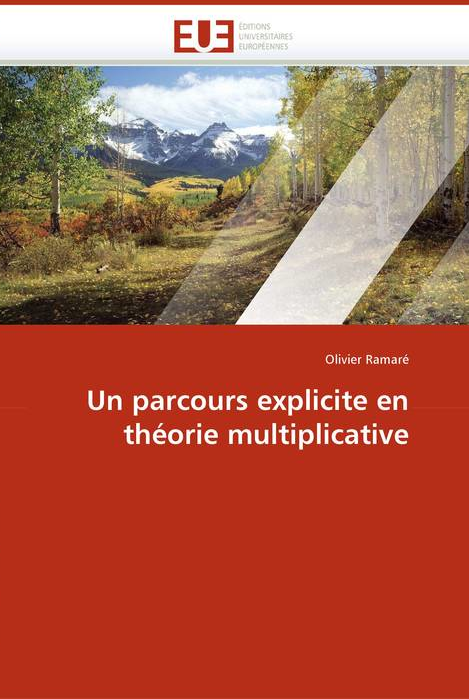
Un parcours explicite en théorie analytique
Une version éditée de la partie non publiée de mon mémoire d'habilitation à diriger des recherches, collection à laquelle j'ai ajouté un exposé sur les fonctions pseudo-périodiques. Pdf Éditions universitaires Européennes (2010), 120 pages. Depuis vingt ans, mon travail porte essentiellement sur les nombres premiers, avec un accent mis sur la nature effective des résultats. Ma thèse d'habilitation à diriger des recherches contenait les articles que j'avais publiés à cette époque dans ce domaine, plusieurs articles d'exposition, ainsi que deux articles non publiés. La présente monographie reprend les parties non encore publiées de cette thèse, et qui sont commentées pour tenir compte des avancées intermédiaires. J'y ai aussi ajouté un exposé sur les propriétés de presque périodicité de certains termes d'erreur en théorie multiplicative. Ce livre parle en conséquence de l'approche géométrique du crible de Selberg, de la constante de Snirel'man, d'un crible local, de majorations et de minorations de $L(1,\chi)$, de formes bilinéaires sur les nombres premiers et enfin d'oscillations de certains termes d'erreur. |

|
Excursions in Multiplicative Number Theory
With the collaboration of Pieter Moree and Alisa Sedunova Birkhäuser Advanced Texts Basler Lehrbücher, 355 pages. This textbook offers a unique exploration of analytic number theory that is focused on explicit and realistic numerical bounds. By giving precise proofs in simplified settings, the author strategically builds practical tools and insights for exploring the behavior of arithmetical functions. An active learning style is encouraged across nearly three hundred exercises, making this an indispensable resource for both students and instructors. |

|
Goldbach et les sommes de nombres premiers
La Recherche, juin 2013, no 476, pages 68--71. Comme me l'a fait remarquer un lecteur attentif, Gérard Cougny, la soit-disant représentation de Christian Goldbach qui accompagne cet article est en fait une photo retouchée de ... Hermann Grassmann (1809-1877) ! La représentation ci-contre n'est PAS non plus CORRECTE, puisqu'il s'agit d'une peinture de Leonhard Euler. Les historiens Adolf P. Juškevič et Judith Kh. Kopelevič, dans le tome 8 de Vita Mathematica portant sur Goldbach et datant de 1983, disent page XI : "Ce livre contient un répertoire ainsi que quelques dessins. Malheureusement, parmi ceux-ci ne se trouve aucun portrait de Goldbach, car apparemment il n'en existe pas" [traduction personnelle de la traduction en allemand de l'original russe]. Je remercie Andréa Bréard de cette référence qui fait autorité. J'en profite pour vous signaler la base hongroise de biographies et de visages de mathématiciens célèbres. Pour autant que j'ai vérifié, cette base est correcte -- mais pas pour la représentation de Goldbach ! Pendant que je suis ici, encore, je signale le texte sur la conjecture de Goldbach de Bruno Martin, texte qui contient notamment une référence vers une version manuscrite de la lettre originale de Goldbach à Euler en 1742. |

|

Il s'agit ici de collecter des textes d'enseignement sur des points précis et si possible demandant peu de prérequis. Qui plus est tous ces textes (oups, sauf deux !) sont en français. Les pages du groupe de travail contiennent aussi d'autres textes, dus à mes corréligionaires (voir aussi ici).